Pages

Sunday, 6 November 2016

Coastal Humidity

Our travel day to Pangani was long and hot. I had tried to buy tickets the day before but one of our new friends – he’s a friend; he’s added me on What’s App. I just can’t remember his name – said that we didn’t need to. Buses to Tanga (where we would have to change buses) leave every 30 minutes. I kept asking which of there were the fast buses to Tanga. “Oh, they’re all fast. Four hours to Tanga. All of them.”

Haven’t sworn on this blog yet, but I have to start. Bullshit.

I knew, from my previous visits, that there are regular buses to Tanga but that two of the companies are known for being quicker than the other ones. Well, we didn’t catch either of those companies. What should have been a 4-hour ride to Tanga, turned into a 6.5-hour bus ride. This was followed up by the slow bus to Pangani. It was slow because it was one of the big busses that drives the route so it had to stop in every village to pick-up and drop-off supplies. Ben, an Englishman we had met in Lushoto, left an hour after us and arrived in Pangani almost two hours before us.

If you could see my face right now, it’s making the Queen Victoria ‘We are not amused’ face.


To add to the joy of the bus ride, once we were out of the Usambara Mountains, the temperature was a cool 32°C with a humidity of 75%. That was it for TC. No more Tanzanian bus rides after that one.

On the upside, this is how the ride ended.
It was followed by a beer. Then another beer.
You will all be relieved to know that Fawlty Tower’s Manuel has been reincarnated as the well-intentioned but social awkward Balthazar of Seaside Community Centre Hostel, Pangani. In his odd, inept way, he kind of made Pangani for us. Our first night there, we decided to stick to the hostel for dinner. Balthazar brought us a menu. We ordered and he let us know that they were out of everything we wanted. What did they have, you ask? Fish. Lots of fish, such as red snapper. Oh, we love snapper. We’ll have that. They’re all out of red snapper. If our plates had arrived with chicken on them instead of fish, I would not have been surprised.

TC and Ben discovered that when you order fish in Tanzania, you get the whole fish. Head, eyes, angry little mouth included. I knew this; I have no idea why I didn’t think to tell them. We ended up ordering a larger fish divided between the three of us. I got the tail which was easy to eat. Ben got the middle, and poor TC got the head.

This was a different order of fish, but you get the idea.
Also, I obviously have no problem with my food looking at me as I eat it.
The thing was, this continued the entire time we were there. Settling our bill after a few beers on the beach? I’d like to pay now. You pay? Yes. Now? Yes. Okay, so you will pay now. Yes. Okay. [Awkward pause while he stands there looking at you.] I will bring you the bill now, yes? Oh good grief, YES!

Perhaps the best service we got was when there was no service because everything
stopped for a Tanzanian Premier League game.
Our days in Pangani were very lazy. For one thing, there isn’t much to do. For another it, it is so hot by 11am that you don’t want to do much. And the humidity! It didn’t matter if you showered in the morning or the evening; the minute you stepped out of the shower, you started to sweat. Sitting in the shade on the beach wasn’t too bad because there was a slight breeze. Walking around town involved multiple stops to have a cold something; pop, water, beer. It didn’t really matter, it just had to be cold!

The view from one of our cold liquid refreshment stops
We lost Ben to beaches on the south side of the river, but we picked up Lucas, a nomadic Dutchman, in the process. He happily came with us to eat dinner, drink beer, and watch soccer his first night. He and TC hit it off and as TC was game to head straight to Zanzibar from Pangani but I had no interest in two weeks on Zanzibar, they decided to head off together while I headed back to Tanga with the intention of heading to Morogoro.

The Pangani ferry crossing the Pangani River
My plans changed when I got to Tanga and had missed the bus I was hoping to catch. Instead of play bus-hopscotch to get to Morogoro, I hunkered down in Tanga for a night intending to catch the direct bus the next day. I’d quote Robert Burns, but I’ve already done that. I decided on a whim to fly to Pemba, part of the Zanzibar Archipelago, for a few days before catching a boat to Stone Town. 

The dhows of Pangani They head out at night to fish.
If you sit on the beach, you can watch their lights blink on the horizon.

Friday, 4 November 2016

Touts, Beers, and Hikes

After our safari ended, I took TC up to Ngongongare to see Jifundishe. We were picked up by the ever gracious Paulo who, other than plans to change the oil in his car, had made sure to free up his day to be at our disposal.

The fields around Ngongongare
On our way in, I did a quick tour with TC of the Jifundishe Library and grounds before we headed out to the staff house for a quick chat with Anne and Deb. Unfortunately, Anande was away at training all week so I missed seeing her again. By all accounts, she was sad to miss me as well, but I’m pretty sure she was just upset that she could no longer come to Cacti House – the volunteer quarters – to eat my leftovers every day.

These three brothers came running out and asked for a picture.
Don't have to ask me twice!
You can walk Ngongongare in about 10 minutes, but we made the most of it and followed a few of my favourite walks out and back so TC could see the countryside as well. We waited for Paulo in front of the duka (shop) on the CCM flag stand as it was the only place to sit.

The traffic in Ngongongare is insane!
CCM stands for Chama Cha Mapinduzi (Party of the Revolution) and it is the current ruling party. Their green flag can be seen flying in almost every village you pass, although it is also common to spot the flag of the main opposition party, Civic United Front (CUF), flying as well. As I explained this to TC, the woman running a small fruit stand overheard and started cheering and clapping for CCM. It was clear who she had voted for in last year’s elections!

Bought my last Coca-Cola baridi (cold) from the duka.
We bought our bus tickets for the next day. Paulo came with us to make sure it all goes okay because apparently I’ve never bought bus tickets on my own in Tanzania… As we walked back to his car, he spotted someone he knew and started chatting. TC and I walked to the car and patiently stood to the side waiting for Paulo to catch up. Instantly, I was swarmed with guys asking if I needed a taxi, they could get me a taxi, here’s a taxi (pointing at Paulo’s car). One of them went to open the door for me, saying “I know this taxi driver. I’ll get him for you.” I pointed at Paulo walking up to the driver’s door, and said “I know him, too. He’s my rafiki (friend).” The tout then asked Paulo to give him some money for finding the fare. Paulo and I looked at each other with ‘what the hell’ faces as the tout realised we already knew each other and disappeared down a side street.

Paulo: taxi driver, Swahili teacher, cheaper-price-getter,
grocery runner, beer provider, and good rafiki.
It was just such an African moment.

We went to Paulo’s favourite restaurant for lunch where we introduce TC to ugali, a corn-mash dish eaten all over East Africa. Ugali is bland and tasteless, but that’s okay because its main purpose is to act as a food-picker-upper for whatever you are serving with the ugali (usually steamed spinach and some sort of meat). Paulo devoured his portion of the ugali; TC and I, in true wazungu fashion, dropped almost as much on the table and ourselves as we got in our mouths. We may have been the butt of a few jokes.

After the hustle and bustle of Arusha, Lushoto was such a nice change of pace. A sleepy little town tucked up in the hills of the Usambara Mountains, Lushoto has friendly touts, chatty locals, and cooler weather. Everything you could want after Arusha! We booked ourselves into the only dry hotel in town because it was also the cheapest, and while I had a nap after our 8-hour bus ride, TC checked out the town and found a little hole-in-the-wall to buy beer. Our evening plans were sorted.

The wall of the Lushoto beer shop.
The main reason for coming to Lushoto is hiking. TC had been contemplating a multi-day hike to the Mtae (a village on the other side of the mountain range) but a knee injury shortly before departure ended that plan. Instead of heading off in different hiking directions, we booked a day hike together to the Mazumbai Forest Reserve. The hike starts with going up about 600 metres and it’s pretty much straight up. I’ll give you two guesses who the slow one was. Hint: it wasn’t the person with the knee injury.

About halfway up to the summit. Lushoto is in that valley behind me.
When we reached the summit of our hike – through the forest to an old German lookout fort – our guide, Ali, made lunch. Who should we run into but Agri, one of my guides from when I was in Lushoto in 2007! He’s doing well, thanks for asking. He’s now working at the Irente Bio-reserve as a guide. Yes, Yassin (my other guide from another trip there) still works at Friends of Usambara. Ah, Lushoto.

Even the middle of nowhere needs a corner store.
One of the great things about doing these hikes with a guide is that they take you through all the backroads and small trails that the locals use. One of the not-so-great things about doing these hikes with a guide is that the backroads and small trails are small. If you stop walking, you can barely fit both your feet on the path.

Two guesses who totally bit it on the walk back to Lushoto. Hint: it wasn’t the person with the knee injury. (Although I had one after I fell!) What a sight the two limping wazungu must have been straggling back into town.

The view from the path through another nameless village
We spent another day in Lushoto to give us time to recuperate from our injuries because Market Day is Thursday and we wanted to check it out. I always love Tanzanian markets, well, food markets. Not only is the food cheap, the colours and atmosphere are always so vibrant. And in a fun twist of events, the declaration of love hurled at me came from a young woman, not a man. She was telling me in Swahili that I was pretty, so I smiled and said ‘asante’ (thank you) as I wandered past. Then, in really loud English, she calls out “Dada (sister), I love you,” and the market full of dadas, mamas, and bibis (sisters, mothers, and grandmas) roared with laughter. What else can you do except laugh with them and say ‘asante’ again? 

Market Day in Lushoto

Wednesday, 26 October 2016

Safari

This post should really be titled "Why You're Actually Reading This Blog".

Paulo and I headed out to pick up TC from the airport last Wednesday night. We had one day of sorting things out in Arusha and then we were off on safari bright and early on Friday for a three day safari.

Enough talk. Picture time!

Day One - Lake Manyara

Elephant spotted just moments after entering the park.

Blue Monkey

"Roads? Where we're going, we don't need roads!"

Zebra against the African backdrop.

"You lookin' at me?" My lunch companion.

This giraffe played peek-a-boo with us with the bushes to the left.

Day Two - Ngorongoro Crater

Warthog

Mr. and Mrs. Ostrich

Water Buffalo checking us out.

Wildebeest blocking our driving route.

Hippo family moving from one pool to another.

Entering the forest area of Ngorongoro.


Day Three - Tarangire

Lioness takes off after a Wildebeest who was silly enough to venture towards the water when the lions were RIGHT THERE!

This chase ended with no food but a move of the pride from one area of shade to another. Later, they would catch a Wildebeest and we would return to see them eating dinner.

Giraffe

Tarangiri is known as 'the home of elephants' for a reason.

We were so close to this elephant, we could almost touch it.

Bull elephant reaching for the acacia tree.

Monday, 24 October 2016

When Kesho (Tomorrow) turns to Kwa Heri (Goodbye)

I left Jifundishe and Ngongongare on October 13th. It already feels like a lifetime ago. Well, it feels longer than a week and a half, at least.

I struggle, when I write or talk about village life in Tanzania, with the idea of romanticising it. So I will say this; life here isn't easy, but it isn't difficult either. When you have never known a life without near-daily power outages, this isn't a hardship. It is simply your reality and you work with what you have.

My last night and morning in Ngongongare, I had clear views to Mt. Meru. I also had the joy of a 28 hour (at the time I left) power outage. Hey, solar power. I love you! Despite the cloudy days and draining my solar power a few days earlier so I could get some work done during the day - power was routinely cut during the day while Tanesco replaced a series of power poles - I had enough power to charge my phone and finish some computer work for Jifundishe.

Mt. Meru in the early morning of the day I left.
I headed to the office for the last time to put the finishing touches on the User Guides I created. As Anne and Deb were off doing work in other places, it was just Anande and myself seated in opposite ends of the staff house with the generator running between us. Conversations usually started with muffled shouting, followed by one of us giving up and walking to the other person's office.

My mornings and evenings were usually spent in this seat. Positioning it here meant I had
a ledge to rest my coffee/beer on, I was facing the right direction to watch the sunset, and
when someone called out 'Hodi' at the backdoor, I only had to lean back to see who it was.
I headed back up to the house to grab my bags and say 'kwa heri' (goodbye) to Frida. When I arrived, I found that she had still cooked lunch (although I told her I was leaving at lunchtime) and that the lunch consisted of all the foods I had commented on when she had cooked them. Frida is friendly enough but the word stoic is definitely one that comes to mind when I think of her. To find that she had done this meant a lot, and I wish I had been more diligent in my Swahili so I could have said more to her than 'thank you very much', 'I will miss you' and 'next time I will speak more Swahili'. Frida, of course, waved off my declarations of feelings as if a fly was hovering around her face, and then she walked away when I asked for a picture.

Looking at the kitchen from the living room.
Again, I don't want to romanticise village life, but I really do slip into it so easily when I'm here. As long as I have my Dial-A-Paulo when I need a ride somewhere (or a beer run on a Friday night...), I enjoy the quiet that comes with living in a small community. My time here just reinforced that I want to do an extended stay again at some point in the future. And while I enjoyed my time of Cradle of Love, my time at Jifundishe feels much more productive. I'm not just another volunteer passing through, I'm actually contributing something meaningful and lasting for this organisation.

My evening view. I'd read my book and either drink tea or beer until the sunset.
I had a few days before my Travel Companion (henceforth called TC) arrived and I really did not want to spend any more time in Arusha. I took the Friday to visit the Tanzanian Tourist Board office and get a bus ticket to Kondoa with the intention of seeing the Kondoa Rock Art. Dark and early Saturday morning, I hopped on a bus headed to Kondoa.

When I reached Kondoa, I contacted the Cultural Tour Guide I had connected with at the Tourist Office, and discovered that the price he quoted me was based on two people taking the tour. As a solo traveller, I'd have to pay the whole price myself. Even on the phone, he said "it's very expensive for one person." Yes. Yes, it is. I could arrange to visit the site myself, but I woke up Sunday morning with some stomach issues. I ventured out to grab some food and water, then returned to my room with cable. There would be no visiting the Rock Paintings on Monday as I had planned.

Despite this, I enjoyed Kondoa. I was feeling better on Monday and was able to walk around the town. It was just far enough off the beaten path that I was an oddity as a white person but everyone was incredibly friendly. It was also almost entirely Muslim which meant that my tattoo was a huge hit because they are forbidden by Islam. Everyone wanted to touch it, and one guy looked like he was going to throw up when I explained how a tattoo gun works. Pretty much everyone here is terrified of needles so the fact that I sat for 40 minutes getting repeatedly poked with one won me a few 'hardcore' points in their eyes.

As I sat on the bus to leave, I realised that I hadn't taken a single picture of the town.

Just a reason to go back, I guess!

Wednesday, 19 October 2016

Back in Arusha Then On The Road Again

I'm posting from my phone so fingers crossed this works! I left Ngongongare last Thursday and then headed to Kondoa for a few days. Internet access down there was very limited!

I've written a few posts but without Internet, they're still on my laptop! I'm waiting for my travel partner to arrive tonight and then we're off on safari on Friday. We are staying in a lodge and most of them have WiFi these days so hopefully I'll catch up on my posting then.

I just wanted to let you know that I'm still alive and I haven't forgotten to post, I just couldn't.

Monday, 10 October 2016

Staying on a Little Longer

Happy Thanksgiving to my Canadian friends and family!

Suck it, rest of you!

First, thank you to my mom for pointing out that I had left the default settings on the comments so you had to login to leave a comment. That’s now fixed, mom. You can write those comments now.

On Friday morning, Anne and I discussed my staying on at Jifundishe for this week as they are installing Shule-Direct this Wednesday. Shule-Direct – shule means school – is the Tanzanian government’s eLearning component of their curriculum. The great thing about Shule-Direct is that it can be loaded onto the RACHEL-Pi server and therefore, it is available even when the Internet is unavailable. All this is to say that I am still in Ngongongare until Thursday.

My home until Thursday
I spent a relatively quiet weekend in Ngongongare. Relatively quiet because the church choir practiced all weekend. They started Friday at 5pm, and they stopped only for power outages, sleep, and the portions of the Sunday Service they weren’t required to sing. Normally, I would love the idea of live music all weekend except they sang three songs. Over and over and over and over and over. Add to that, the lead singer is tone deaf and kept trying to hit notes well outside her limited range. I know it’s a small village and they are reliant on the talent available, but I refuse to believe this woman is the best this village has to offer. When they finally stopped at 10pm Sunday night, I was tempted to go outside and start cheering.

Other than the cacophony from my neighbours, it was a weekend where nothing really happened. I relaxed, read a novel, went for walks, practiced my Swahili with Frida, stopped by the local duka (shop) for Coca baridi (cold Coke), and picked up Anne’s cold from last week.

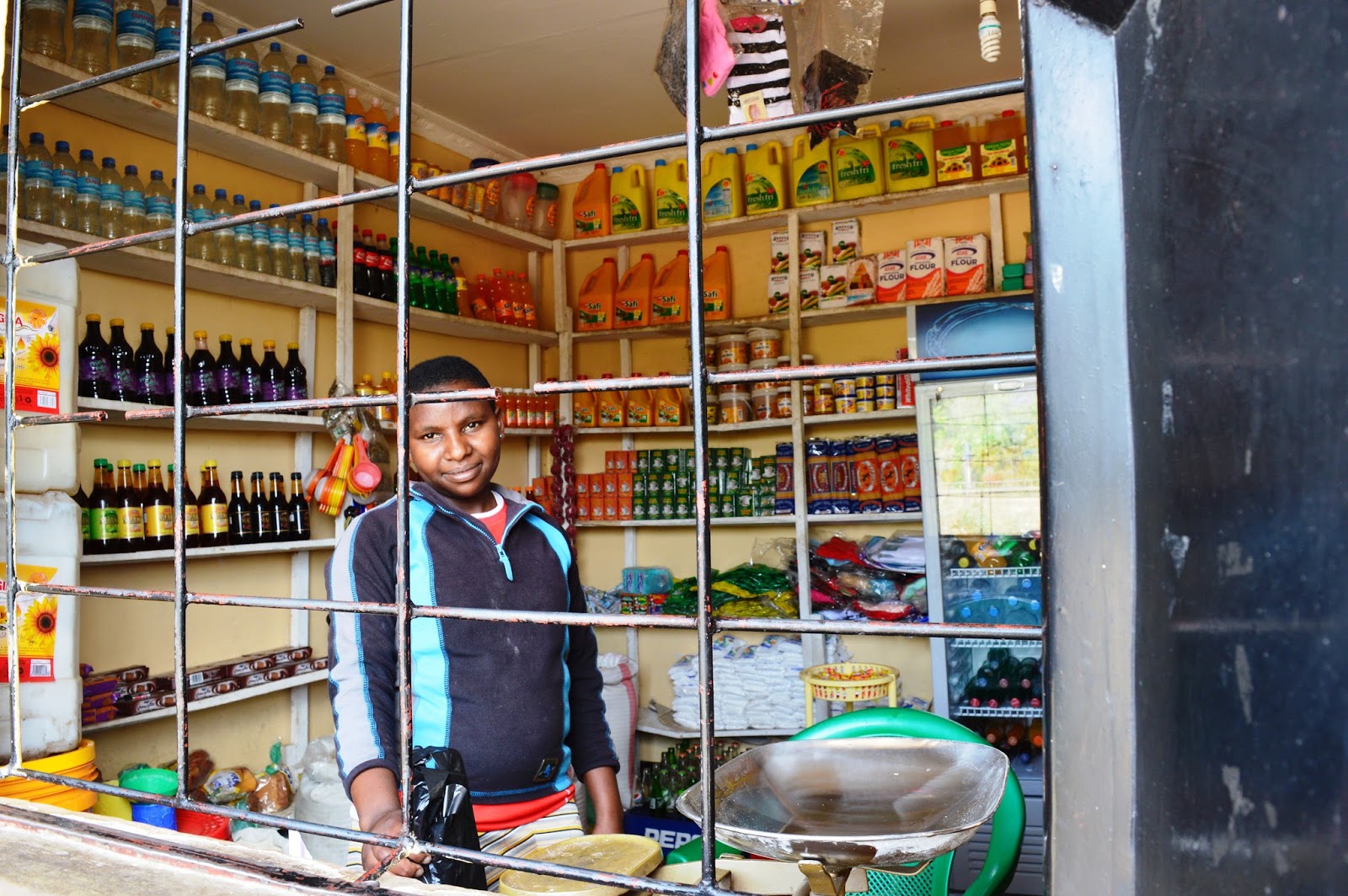
The blue-ish duka in the middle is where I buy my Coca baridi
Okay, so that last part wasn’t so fun but Anne passed on her cold medicine and I’m feeling much better. It’s agreed that if I still have a sore throat tomorrow then I’ll head to the clinic to double check. Poor Frida looked so concerned when she saw me take the medicine at lunch today; I had to assure her that the dawa (medicine) was not related to her cooking.

Where I spend my days
Today, I started introducing the students and teachers to RACHEL-Pi. Well, a student-teacher today, Amret. I had him walk through my instructions on how to switch from the Internet to RACHEL-Pi. Initially, he was unimpressed by what appeared to be just a regular internet page. Then I explained to him that you could use this when the internet is down or when the power is out. I could have told him I was giving him $1,000,000 and I think his reaction would have been the same.

Then I showed him that he could connect with his phone.

“But then I have to use data.”
“No. When you connect to RACHEL-Pi, it doesn’t use your data. You are connected to their free server so it costs you nothing.”
“So, I bring my phone to Jifundishe, open up one of these books on RACHEL-Pi, read it, and it will cost me nothing?”
“That’s right.”
“So, the computer lab is full, I can still study these Wikipedia articles on my phone.”
“Yes.”
“And it doesn’t use my data?”
“No.”
“I have to tell my class. I have to tell everyone.”

As I was packing up, he was already showing other students in the computer room how to log onto the server and I felt a small twinge of remorse that I had to take the server away albeit temporarily. We walked out together chatting about RACHEL-Pi and what it would mean for the students. When we came to his group of friends studying on the lawn, we said goodbye and I headed back to Cacti House (the volunteer quarters). He was talking to his friends too quickly for me to catch what he said, but I did hear him say “RACHEL-Pi”.

Education is, in my opinion, one of the cornerstones to eradicating poverty. Whether in a formal classroom setting or through visiting a free library, education can improve lives. Even just the simple knowledge of how to keep a clean water source safe can help a community. RACHEL-Pi is the brainchild of a group called World Possible. In the words of Amret today, "they really do make the world possible." Please visit their page and consider making a donation.

Some of the students heading home

Thursday, 6 October 2016

Village Life

I did it! I left Arusha!

It wasn’t quite on the Monday as I had planned – I have the Ministry of Home Affairs (Immigration) to thank for that – but it happened. Bright and early on the Tuesday morning, I hopped in the cab of Paulo’s friend, stopped at MOHA to pick up my now twice-stamped passport, and made the drive out to Ngongongare.

The painfully slow drive out to Ngongongare.

They’re expanding the road two a dual-carriageway between the border all the way to Moshi – and Paulo thinks this is all going to be done by February, he has much more faith in Tanzanian work ethic than I do! – and they’re just east of Arusha at the moment. With no lines on the road – HA! When are there ever lines? – and big chunks of pavement missing, driving along the road was a bit of a free-for-all.

Plus, it had started raining on Monday night and while it had abated after the initial onslaught, it didn’t stop until shortly after 8am Tuesday morning.

When it rains this hard, you take shelter where you can.
Even a gas station.
I think I’m cursed when it comes to travel weather. My first time in Switzerland in 1999, they had the worst flooding in years, and my train into Interlaken was the last one in or out via Thun for two days due to flooding on the track. My last time in Switzerland in 2013, they had horribly raining weather and it even snowed ON MAY 24TH! Last time I was in Tanzania, the locals complained about how wet the dry season was and that they still had to mow grass that should have been brown by then. This time? It has rained almost every day and the locals are complaining about how wet the dry season is.

I’m sorry, Tanzania.

But the northern part of the country has also been in semi-drought status for a number of years so you’re also welcome.

Two things have happened since I was last here. 1) The library moved to a larger location in the next village over. 2) There is now a volunteer house to stay at on the same plot of land as the library. My previous trips have all been driving to Deb’s and then walking to Imbaseni from there. The road to Deb’s is rough. The road to the Jifundishe library… well, first off, let’s stop calling it a road. Calling it a road is giving it airs. It’s exposed rock face occasionally filled in with dirt. How we made it to the library in a car will forever be a source of mystery for me.

This is the flattest part of the road.
It took less than a minute of being here to undo all the stress and frustration of my week in Arusha. I wouldn’t call my days lazy, but definitely chill. Jifundishe recently got RACHEL-PI which is a small data hub (like a server) that contains Wikipedia for Schools, a bunch of Khan Academy resources, Farming and Husbandry documents created by a Kenyan company (so transferable to here), and many other resources which will be a definite benefit to Jifundishe as a whole. The best part is you don’t need the internet to access these resources, you just need to connect to the hub. The hub itself can be plugged in or run off of its own chargeable battery. Just in case it’s not abundantly clear, I’m pretty jazzed about this thing.

What I’m not jazzed about? It’s a lot of information but it’s not exactly user friendly. Hmm, I wonder what I, with a background as a Technical Writer and Instructional Designer, could possibly be working on while I’m here?

Not ‘toning down my sarcasm’, that’s for sure.

Because of the short duration of my stay – I’m back to Arusha on Saturday – I opted to have Frida (Free-da) cook for me instead of having to deal with getting my own food sorted. She undercooks the vegetables and overcooks the pasta and rice, but the meals are amazing. At first I was on the fence about having someone cook for me because I know that I can handle doing it myself, but that first bite of the first lunch was heavenly. She always cooks too much and it takes every ounce of restraint I have not to gorge myself on her cooking.

Lunch time!
She doesn’t speak much English but she’s very patient with my Swahili. I think she was pleasantly surprised on the first day to realise she doesn’t have to shake the coffee and tea at me when she asks “Kahawa au chai?” I also make sure that even thought it’s technically my space she is cooking in and I can just enter, I call out “Hodi” when I arrive and I wait for her to respond. This might not be her house, but she’s been here longer than I have and will continue to cook in the kitchen and clean the living space long after I’m gone. The least I can do, is show respect in our interactions.